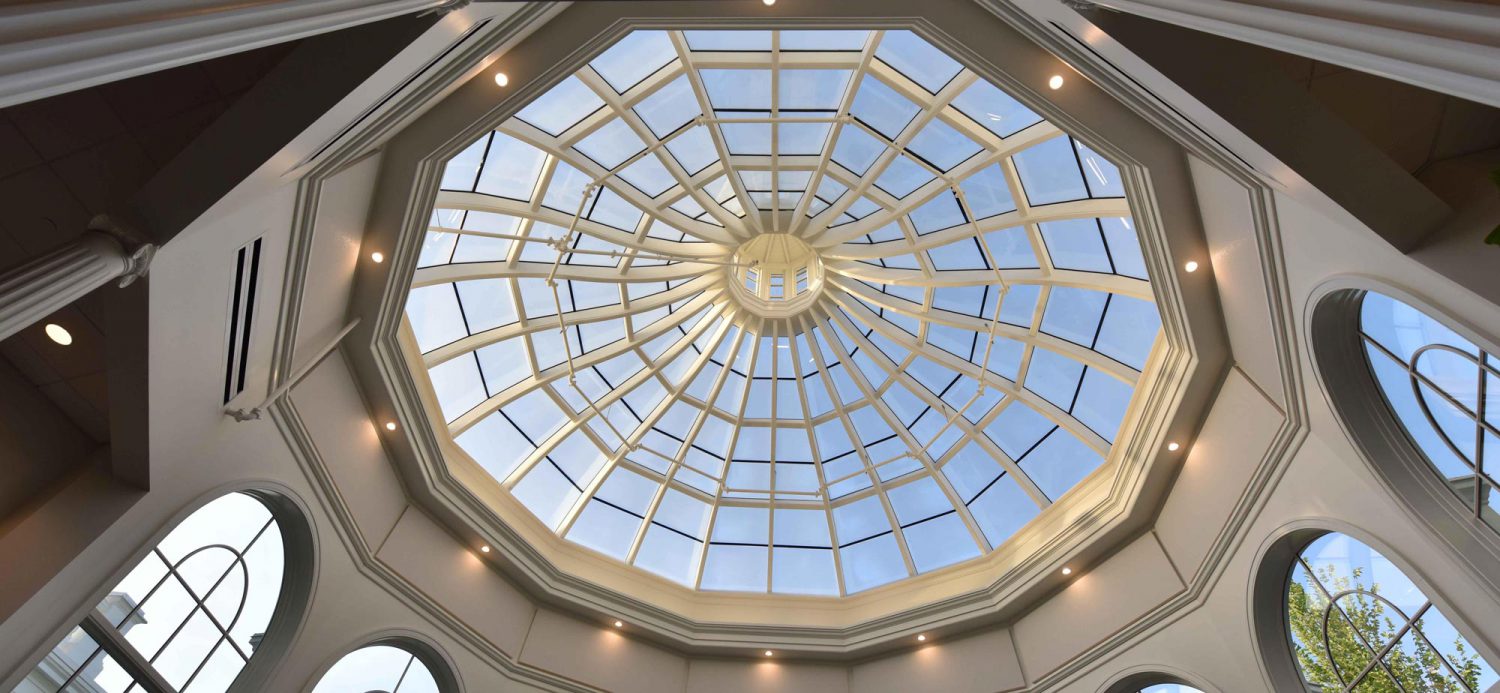
Biosphere 2: One of the 50 Wonders of the World
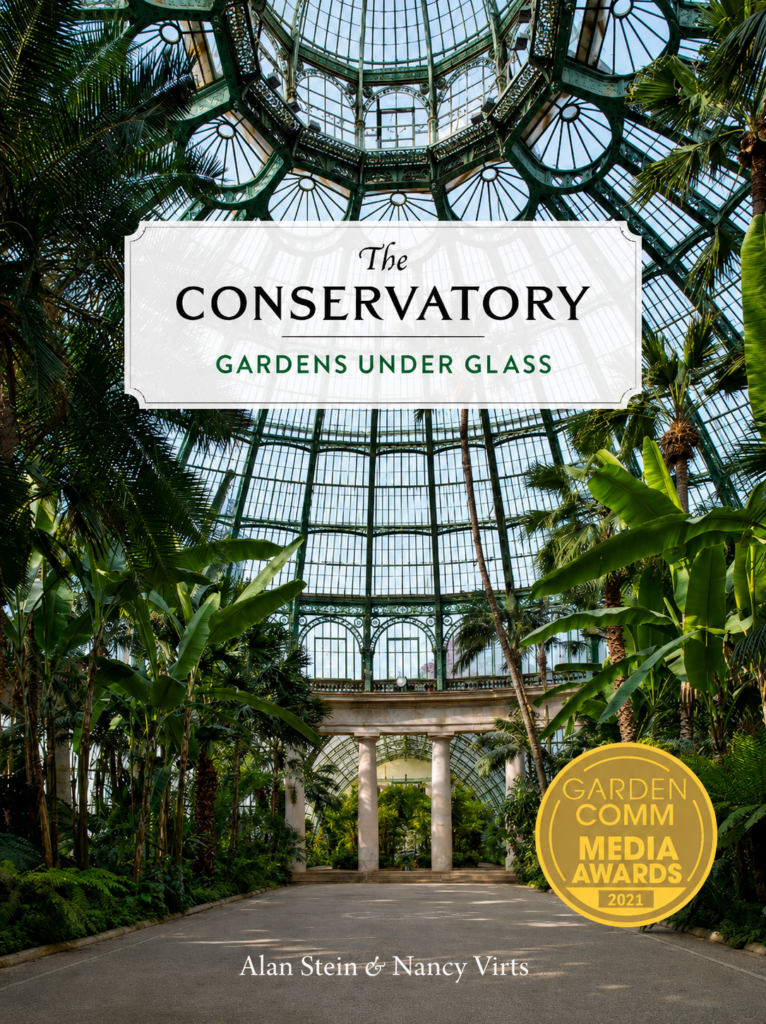
Recently named by Time Life Books, as “one of the 50 must see ‘Wonders of the World’”, Biosphere 2 in Oracle, Arizona is an interesting study in agriculture and architecture. Built between 1987 and 1991 and named after Biosphere 1 ( Earth is known as Biosphere 1 and is the only currently known biosphere), Biosphere 2 was developed to explore the relationships between, and within, life systems wholly contained within an artificial, closed-off ecological system. The idea was that study could be undertaken on the earth’s biosphere without harming it.
Biosphere 2 is the largest enclosed indoor ecosystem ever created, equal to about two and a half football fields (250 yards) that sits on 40 acres at the base of the Santa Catalina Mountains, 4,000 feet above sea level. The biomes (synthetic ecosystems designed to mimic climatic and geographic communities of plant, animals, and soil organisms) within Biosphere 2 include:
• 6,233 feet of rainforest
• a 2,788 foot ocean (complete with a coral reef)
• 1,476 feet of mangrove wetlands
• a 4,265 foot savannah grassland
• 4,593 feet of fog desert
• an 8,202 foot agricultural system
• human living areas
• an underground infrastructure
The enclosure is heated and cooled using water that circulates through piping systems, passive solar glass space frames (lightweight rigid structures made from interlocking struts (or trusses) in geometric patterns) panels and electric power supplied through an onsite natural gas energy center.
Steel tubing and high-performance glass and steel frames are used to construct the aboveground portion of Biosphere 2. The window seals and structures were made to be almost perfectly airtight, so that the air exchange would not interfere with the experiments being conducted inside. Especially notable was how the structure dealt with atmospheric expansion. Heat from the sun during the day causes air to expand and at night it cools and contracts. To deal with these constant expansions and contractions, special diaphragms called lungs were kept in domes. To keep the structure cool, large air conditioners were required.
Some interesting facts about the Biosphere 2 building: it is 91 feet at its highest point; there are 6,500 windows and 7,200,000 cubic feet of sealed glass; it is sealed from below the earth by a 500-ton welded stainless steel liner. This “Technosphere” as it is known, is nearly 3.14 acres large and it houses all the mechanical, plumbing, and electrical systems needed to run the facility. The mission of Biosphere 2 today is, “To serve as a center for research, outreach, teaching and life-long learning about Earth, its living systems, and its place in the universe.” There are two divisions within Biosphere 2, B2 Earthscience, and B2 Institute.
After the facility was completed in 1991, eight people, including a medical doctor, entered the facility on September 26 and began a two-year closed “mission” to attempt to see if the Biosphere was capable of sustaining human life. Animal and agricultural husbandry was used to produce the food needed by the eight-member team. Eighty-three percent of the total diet consumed by the inhabitants during the first year included bananas, wheat, sweet potatoes, peanuts, rice, papayas, and beets. During the second year, the team was able to produce over a ton more food than they had produced during the first year!
The first mission ended exactly two years to the date it started. The second and final mission started on March 6, 1994 and was supposed to last ten months. A team of seven individuals entered but on April 5, 1994, members from the first team, after a dispute with the management team, intentionally vandalized the Biosphere project by opening a door and violating the closure. Soon after, two members of the second team left the enclosure and were replaced by two others. However, in June 1994, the ownership and management company dissolved and the mission ended on September 6, 1994.
In December 1995, Columbia University (New York City) took over the management of the site from its owners (Decisions Investments Corporation) and ran Biosphere 2 as a research site and campus for eight years, after which management reverted to the owners. In 2005, the 1,600-acre campus was put up for sale. In June 2007, DDO Ranching & Development, L.P. bought the property for $50 million and on June 26, management of the site was given to the University of Arizona for the study of climate change and other scientific studies. On July 1, 2011, CDO Ranching &Development officially donated the land and buildings to the University and the Philecology Foundation pledged $20 million for continuing scientific studies and operations.
Biosphere 2 is open daily to the public (with the exception of Thanksgiving and Christmas days) and is located north of Tucson, Arizona at the base of the Santa Catalina Mountains. To learn more, visit Biosphere 2 on the web.
Scrap Wood Becomes Art
Here at Tanglewood, we’ve always known that each raw piece of wood which enters our workshop leaves as a work of art—whether a beautiful pilaster, a delicate window grille or a sturdy truss in a one-of-a-kind conservatory or estate greenhouse. But what happens to the leftover scraps of our exotic Sapele wood?
Usually, any scrap that is too small to reuse is simply discarded. Until now…
Olivia, one of our craftspeople, found a great use for some of the scrap, turning it into a beautiful double cross sword rack and archery bow rack as gifts for her nephews.

A chance meeting between Olivia and a fellow woodworking enthusiast led the Chesapeake Woodturning Guild (CW) to our door. Since 1992, this mid-Atlantic based group has been a certified chapter of the American Association of Woodturners (AAW). The group brings together beginner, intermediate, and advanced turners (some with national recognition!), all with the shared mission of providing education, information, and organization to those interested in turning wood.
So what exactly is woodturning? Simply put, it’s a form of woodworking that is used to create wooden objects on a lathe. Where woodturning differs from most other forms of woodworking is the wood is actually moving, while a stationary tool is used to cut and shape it. Various tools and techniques are used to coax a shape out of the wood. In some cases, wood that is still ‘green’ is initially shaped, then set aside to dry (or ‘season’) for a period of time, and eventually the shaping is resumed to create the final product.
Here is a picture of our craftsperson, Olivia, showing a beautiful bowl created by Chuck Engstrom, a member of the CW, using a scrap of Sapele rescued from our dumpster.

Tanglewood craftsperson, Olivia Larlham
A quick search of the internet reveals many beautiful wooden works of art created by woodturners, from bowls to ornaments, vases to pepper mills, and platters to magic wands. Nearly all types of wood are used, and sometimes multiple types are married in a single project (called ‘segmented turning’) to create a beautiful pattern from the color and grain variations in the different wood species. Woodturning projects can take months to complete, and works from master woodturners can cost several thousand dollars.

Segmented wood vase, featuring three species of wood, created by Tim Moore (CW)

Wood and copper vase ‘turned’ by Tim Moore (CW)
Chuck Engstrom and Tim Moore from CW visited our workshop recently to pick up some Sapele scrap that otherwise would have been destined for the dumpster. In return, they presented Alan with a handsome set of salt and pepper mills ‘turned’ from Tanglewood’s leftover Sapele wood by CW member Lou Rudinski.

Chuck Engstrom (CW), Alan Stein, and Tim Moore (CW)
This wasn’t Chuck’s and Tim’s first trip to Tanglewood, and it surely won’t be their last. They confided they were more than happy to make the drive to retrieve such precious wood to feed their woodturning passion.
Happy Holidays from Tanglewood Conservatories

It’s that time of year again—-time to celebrate a year well-lived and time to look forward to a new year full of possibility. We hope your 2011 was full of fun & love & lasting memories. Our wish for the coming year is for each of you to live your life to the fullest and lend a helping hand to those who need it. Volunteer your time, donate a couple of dollars (pesos, bhat, euros, yen…), hold the door open for someone, share a smile. The price is small, but the value is great!
Happy Holidays from the Staff at Tanglewood Conservatories
“ExportMD Award” Helps Tanglewood Conservatories Get to China
There is a lot of excitement here as Alan & Nancy, co-founders of the company, head off to China this month to explore export opportunities for Tanglewood’s beautiful hand-crafted custom conservatories and estate greenhouses. It’s something the company has been considering for a while, especially as more people around the globe have become aware of our brand and the exquisite work we do.
Our company was recently selected to receive the “ExportMD Award”, in support of our efforts to promote our products in other countries. The Maryland Department of Business and Economic Development’s International Investment and Trade Office awards the “ExportMD Award” grant to Maryland’s small and mid-sized companies to help offset the costs of marketing internationally. Companies are eligible to receive up to $5,000 in reimbursement for expenses associated with an international marketing effort.
“We have been working closely with the state of Maryland and with the trade experts at DBED’s International Investment and Trade Office to investigate ways to promote our products overseas,” says Alan Stein, President and Director of Architecture at Tanglewood Conservatories. “We really excited about this opportunity, and we are grateful for the support of DBED’s people in China.”
Watch this blog for updates and photos from the trip. Zai Jian!
Conservatory Auction benefits Preservation Maryland Organization
I recently wrote about one of our beautiful conservatories being up for auction to benefit the Preservation Maryland organization. The fundraising event was held on the site of the historic Wye House in Talbot County, MD. The auction included many wonderful items featuring the best of each county comprising Maryland’s scenic Eastern Shore. The beautiful 21’ x 13’ Georgian-style conservatory was certainly a stand-out among the items up for bid at the event. I’m thrilled to report that the conservatory will soon have a new home and a loving family to enjoy it.
The event was held on a gorgeous sunny Sunday afternoon. We certainly couldn’t have asked for better weather! The approximately 300 people in attendance at the event were treated to great music and delicious local fare, including oysters on the half shell and Maryland’s famous Smith Island Cake.

The Wye House in Talbot County, MD
Read more about The Wye House…

Tours of the Wye House Farm and its famed orangery were provided to guests at the event. We took the opportunity to walk in the actual footsteps of those great artisans and prominent historical figures, like Frederick Douglass, who tread this same ground before us. As the sun began to set, we watched the shadows grow long from within the majestic 226-year-old structure.

As we said before, our whole Tanglewood team is thrilled to have one of our own conservatories being used to help preserve other pieces of our history. We truly hope that each of the conservatories we create today will become a precious part of the history of the families around the globe whose homes they grace.
“Mums & Memories” Show at Baltimore’s Conservatory
What a great way to spend an afternoon—wandering thru an historic conservatory filled with exotic flowers! The conservatory in Druid Hill Park (Baltimore, MD), formally recognized as the Howard Peters Rawlings Conservatory, offers a unique opportunity to see the creative spirit of a great historic glass structures up close AND to walk among some of the most exquisite specimens of chrysanthemums anywhere. Huge football mums, exotic spider mums, quills, spoons, incurves, and more…
The conservatory in Druid Hill Park is a local treasure and an important part of Tanglewood’s heritage. The original structure was completed in 1888 and consisted of the Palm House and the Orchid Room. Designed by architect George Aloysius Frederick, the Palm House, with its 175 windows soaring 50 feet into the air, is a spectacular example of Victorian architecture. The adjacent Orchid Room, although smaller in scale, is equally stunning. The conservatory is one of the oldest surviving glass conservatories in the United States and is listed on the National Register of Historic Places.
“Mums & Memories: A Look at Baltimore’s Horticultural Past” is the theme of the show which runs Wednesdays – Sundays, 10am to 4pm from October 29 thru November 20th. Exquisite mum specimens complement a history exhibit that tells the story of horticulture in Baltimore from the mid-1850’s. For more information, call 410-396-0008. Visit the Conservatory’s website at: http://www.baltimoreconservatory.org.
Adventures in Steel & Bronze
More often than not, our conservatories are constructed of wood, cradling the glass with beautiful arching lines, soaring angles, and exquisite detailing. A client recently asked: Could Tanglewood Conservatories create the same magic with steel and bronze? The answer is a resounding “YES!”
Great conservatory architecture invites you to linger and enjoy its rich details, fanciful embellishments and sensuous curves, regardless of the construction material. And so, eventhough we typically work with wood, our versatile team of engineers and craftspeople dove right in, creating a plan for a one-of-a-kind steel, bronze, and glass observation deck for the property, as well as an accompanying roof-lantern-style cap for the elevator in the home (shown here during the installation).

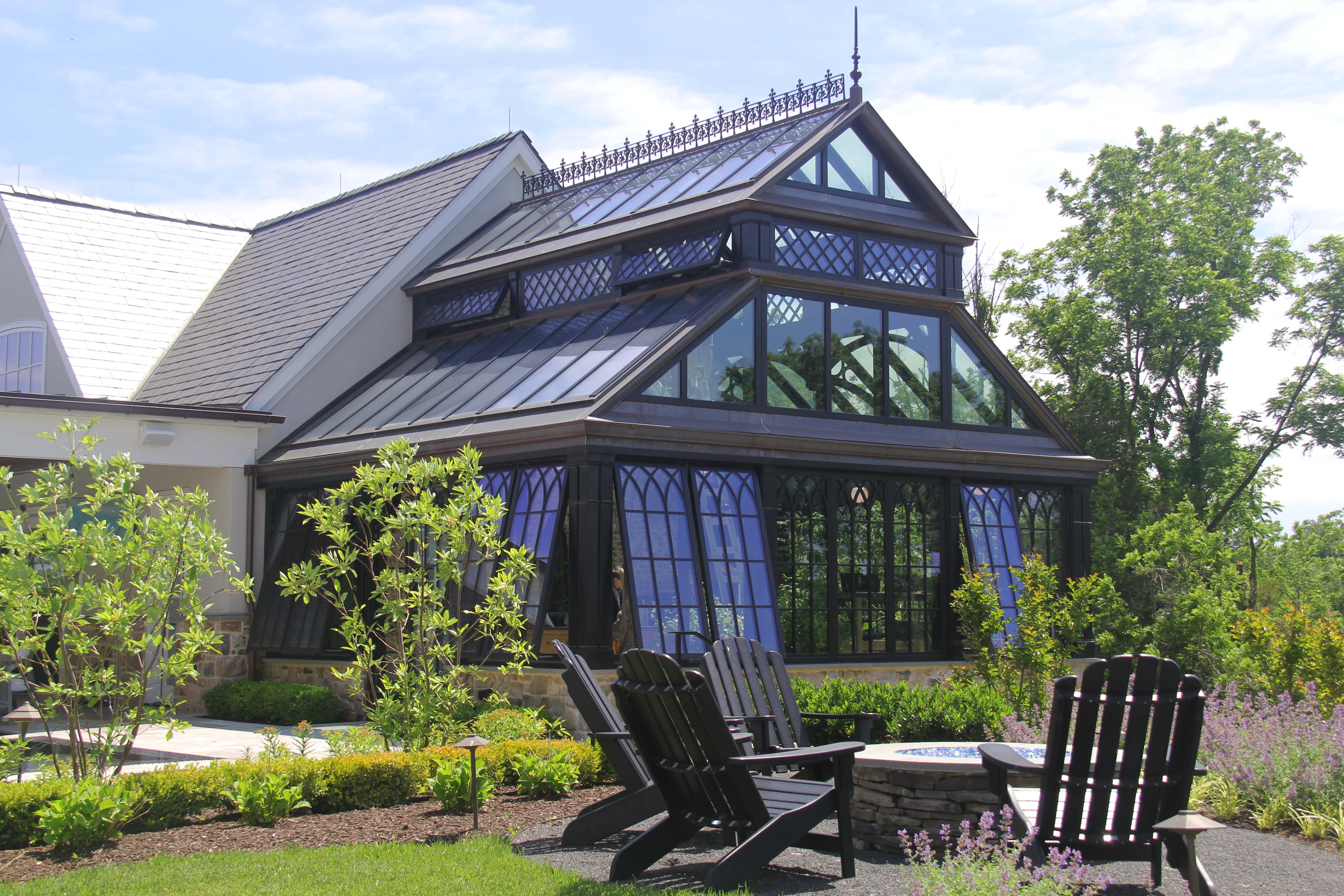
Looking at either structure from the outside, you will see nothing but rich bronze decorative work framing pristine glass. Our team engineered and created an exterior shell of beautiful bronze, providing strength, weather resistance, and an “old world” look. The metal is completely raw, yet flawless.
That perfection is mirrored on the inside as well, where the steel ribs of the observation deck add architectural intrigue and become part of the home’s decor. From our previous work in creating steel structures, we knew the project would require special care, as the joints must be both structural and decorative. The great glass houses of the nineteenth-century often had intricate patterns in the steel to add design interest and to lighten the structure. Could we include a design to be laser-cut into the steel ribs of the conservatory? —the client wanted to know. Absolutely!


Since the client has a background in mathematics, a historically significant mathematical sequence was selected for the design in the steel. The Fibonacci Sequence has been around for many centuries and enjoyed a resurgence in popularity in the past decade thanks in great part to the book (and movie) “The Da Vinci Code”. For the uninitiated, Fibonacci (also known as Leonardo Pisano Bigollo) was a 12th century Italian mathematician, considered by some “the most talented western mathematician of the Middle Ages”. He is credited with spreading the Hindu-Arabic numeral system in Europe, recognizing that arithmetic with Hindu-Arabic numerals is simpler and more efficient than with Roman numerals. (Thank you, Fibonacci!)

In the Fibonacci Sequence of numbers, each number is the sum of the previous two numbers, starting with 0 and 1. This sequence begins 0, 1, 1, 2, 3, 5, 8, 13, 21, 34, 55, 89, 144… Our design team incorporated the first part of the sequence into each of the steel ribs in the core structure of the conservatory. Starting at the apex, you can see the following pattern of holes cut into the steel: 1, 1, 2, 3, 5. The resulting structure is a truly unique work of art, incorporating centuries-old design and 21st century technology.

Passport to Africa
Our Tanglewood workshop is buzzing with excitement as we kick-off the development phase of our first conservatory structure destined for the African continent. The exotic locale has our Installation Team dreaming of all things Africa—photo safaris, encounters with wildebeests, giraffes, and lions on the picturesque plains, gorillas and colorful songbirds in the jungles, beautiful desert oases… Oh, and the actual installation, of course!

Here’s Tom, one of our Installers, enjoying some
downtime during a recent project in Hawaii.
After literally searching the world over for 18 months to find the right manufacturer, the client selected Tanglewood Conservatories to complete their project. Along with their architect, the client had traveled to the U.S. to visit our workshop, and had seen firsthand the quality of our design & craftsmanship. They were drawn to us because of our ability to listen & collaborate with them to create something truly special and unique. That’s something our clients love about us. In fact, it’s not unheard of for them to want our design talents for more than just conservatory projects. For example, a couple in Pennsylvania had us design and build a conservatory for their primary home, and they were so impressed with our quality and Project Management, they asked us to design and build their entire new 2nd home as well!

Conceptual drawing of Orangery
In the meantime, our Design/Engineering Team is finalizing the plans for the structure for Africa, incorporating the client’s wishes along with their own creative ideas. Our Construction Team will build the one-of-a-kind ‘French Country’ style Orangery out of beautiful equatorial African hardwood—imported to America for shaping and construction, and then returned to its native land in the form of a light- and warmth-filled space for gathering family and friends.
We love projects like this that allow us to flex our design muscles to create something that uniquely expresses our client’s desires. And we love to share our excitement with you all! Watch my Blog for updates & photos as we move through the phases of this remarkable project.
Tanglewood Conservatories Helps to Preserve History
Walking through our Tanglewood workshop on any given day, you’ll see amazing, one-of-a-kind structures beginning to take shape as the various phases of construction are completed. You’ll witness the quiet concentration of our extremely talented craftsmen and craftswomen as they create reality from our clients’ dreams. What you’ll also see is how we pay homage every day to the incredible artisans of centuries past by enhancing their techniques and by weaving pride & perfection into everything we build.
Our team now has another opportunity to honor past artisans, as one of our beautiful conservatories will be auctioned at an event in October to benefit the Preservation Maryland organization. Founded in 1931 as the “Society for the Preservation of Maryland Antiquities”, the group is dedicated to preserving Maryland’s historic buildings, neighborhoods, landscapes, and archaeological sites through outreach, funding and advocacy. The October event, entitled “Celebrate Our Eastern Shore Heritage” will include a silent auction representing the best of each county. The featured Tanglewood conservatory is a beautiful 21’ x 13’ Georgian-style conservatory, shown in the artist’s rendering below.

The proceeds from the auction will go towards furthering the preservation efforts for beautiful centuries old structures such as the Wye House Farm—a National Historic Landmark in Talbot County, MD—which also serves as the venue for the event. Tours of the property will be offered during the event, and participants will be treated to traditional local fare and libations while enjoying a photographic exhibit of the area’s 365 National Register properties and meeting their owners.
Our whole Tanglewood team is thrilled to have one of our own conservatories being used to help preserve another precious piece of history. And we hope that each of the conservatories we create today will become a precious part of the history of the families around the globe whose homes they grace.
Tanglewood Conservatories Featured in HOMEFRONT Magazine
We made mention in our July post that HOMEFRONT Magazine featured one of Tanglewood’s conservatories in its summer 2011 issue. However, that is not the complete story. We would like to continue the tale and tell you a little bit more!
HOMEFRONT Magazine is published quarterly and each issue features “a sneak preview of the world’s finest in design, lifestyle and travel. Written by a team of respected experts in their chosen fields…” We are thrilled to have been chosen to have five different conservatories in this issue.

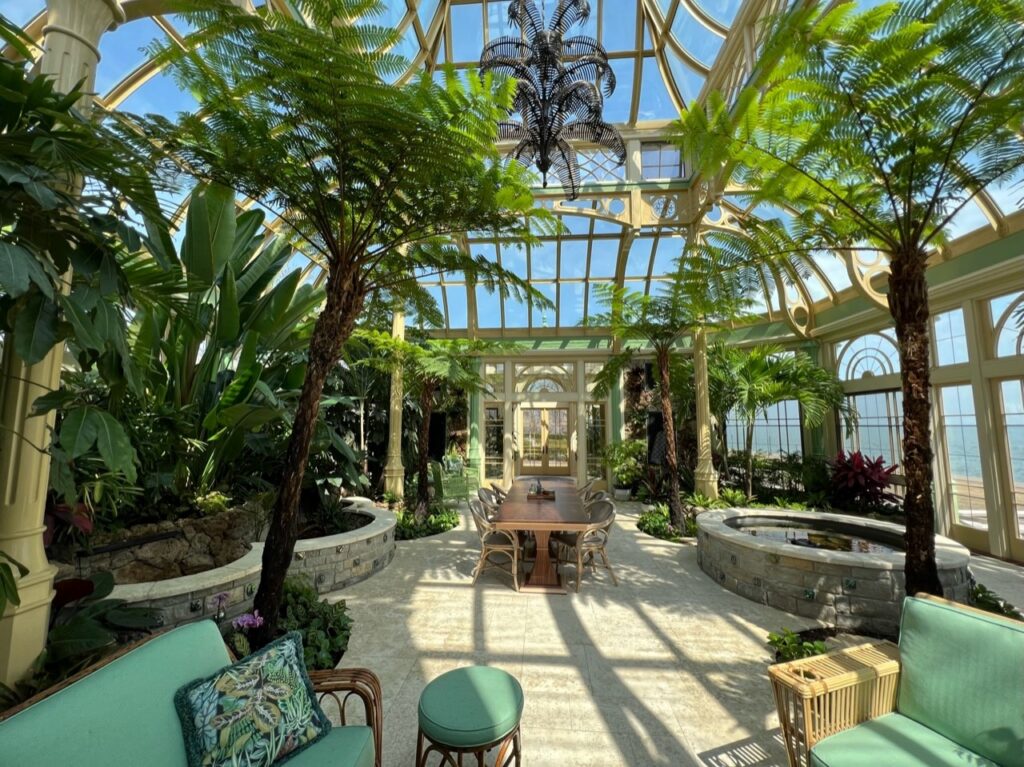
“Enamoured with Conservatories” begins with a greenhouse whose three sets of French doors open onto a stone patio set with a wicker table and chairs; the perfect setting for an early morning cup of coffee, a late morning brunch, an after dinner drink or anything in between. This large (21 feet wide, 28 feet long and nearly 20 feet high) Tanglewood conservatory is located in Florida on land that slopes towards a river. The glasshouse was added to the home as part of a major restoration of this historic property.
The next page features the poolside conservatory that graces the cover of the “Der Neue Wintergarten Ratgeber.” This bright and inviting glasshouse was created to provide the perfect place to relax or change before or after a vigorous or languorous swim in the pool or after an exercise session in the suite of exercise rooms located beneath it and connected by a spiral staircase! This Tanglewood conservatory, located in Glen Cove, New York, “beckons with the promise of a refreshing dip, an iced drink and a magnificent sunset.”
The third conservatory, located on the lakeside Riverstone estate in Foxburg, Pennsylvania, was added onto the historic mansion (built in 1828 by George M. Fox, the founder of the Quaker religion) during a major renovation in 2000. This magnificent room, over 1,000 square feet, has windows on three sides and a cupola on top that “washes the room with daylight.” Imagine, sitting in an overstuffed chair on a late fall day, watching the sunset, reflecting off the lake, mirroring the surrounding fall foliage. For more information, you may want to read Tanglewood’s founder, Alan Stein’s, blog post about the estate and its “most loved and commented on custom conservatory projects” being up for sale in January 2010.
The Minneapolis, Minnesota owners of our fourth conservatory first envisioned a sunroom in which to keep and grow their exotic plant collection, including Hibiscus and varieties of ferns. However, the room has become much more, and now is also used as an intimate gathering place for social functions.

Our fifth and final conservatory uses no artificial light even when the day is overcast. “…antique sconces make it glow like golden amber” in the evenings and on cloudy days. This addition to a hilltop stone cottage in North Carolina was built “using panes of glass each slightly differing in width.” Imagine viewing the valley below during the transformation of seasons, from summer to fall, and fall to winter. The colors must be spectacular!
We hope you enjoyed perusing HOMEFRONT’s summer 2011 issue as much as we did and that it has given you some ideas for your upcoming conservatory, glasshouse, greenhouse, or orangery project!