Glass Houses
Forget Politely Pale: Go For The Gusto And Never Look Back
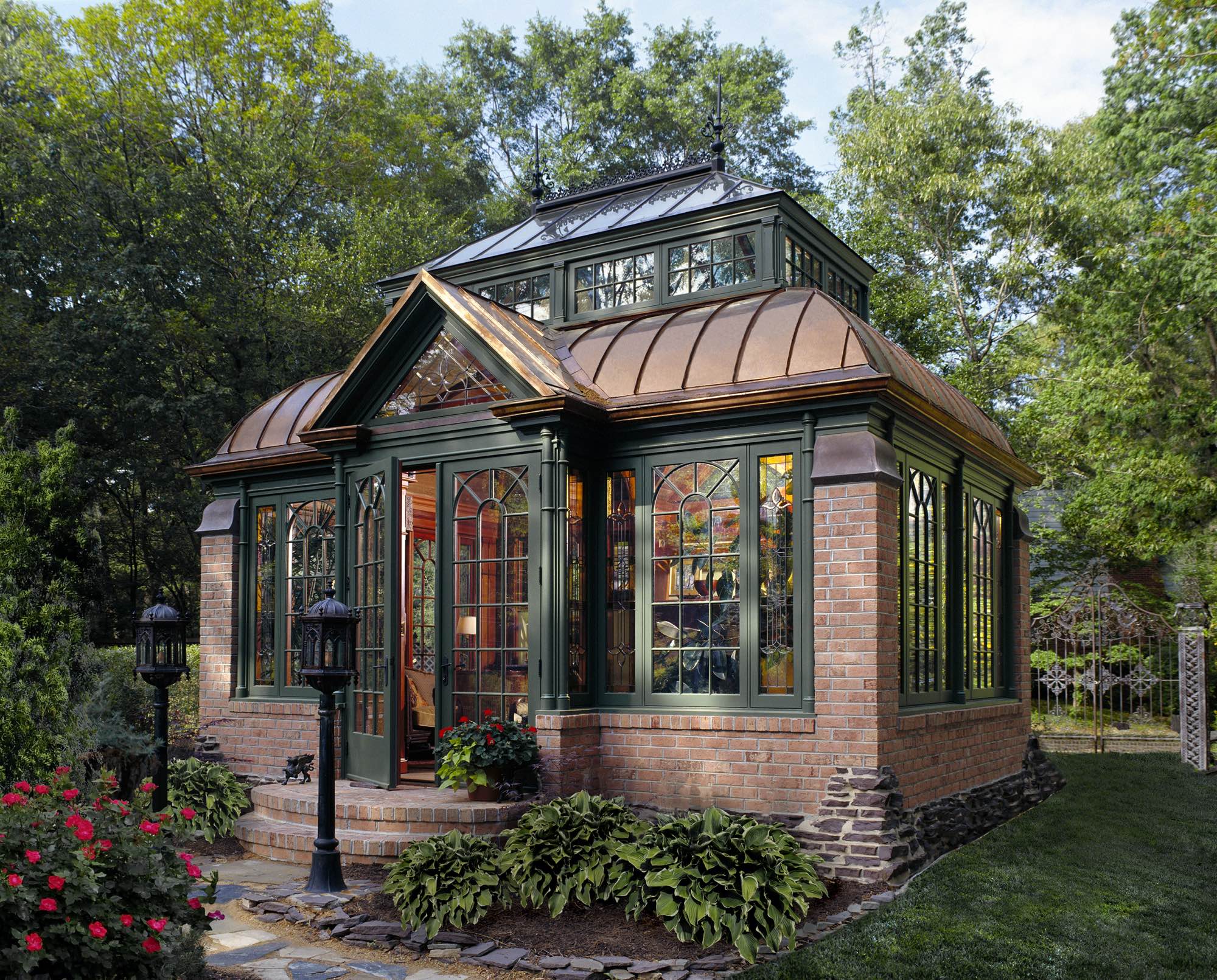
In the heat of the summer, in the heart of New York, we challenged the notion of what a conservatory can be. Alan Stein of Tanglewood Conservatories, Ltd., a Maryland design firm, created three separate glass house conservatories, and installed them as the centerpiece of the Rockefeller Center Flower & Garden Show. The highly charged colors, taken from a 1930's painted carnival sign, captured our feeling best.
That exuberant burst of line and color became our mantra. After that, nothing was design-as-usual. We urged Michael Golden to make his Italian ceramic tile floors dance with eye-popping pattern and texture.
No white wicker allowed: instead, McGuire's richly woven Umbria lounge chair and ottoman with cushions covered in the surprise of Schumacher's rose and melon Moire Stripe.
Gold in the garden? Sure, if it's Donghia's Venetian glass chandelier, hovering over Michael Vanderbyl's center table
of pale English sycamore for Baker.
Glass roofs need ceiling blinds;
these by Appeal, are made for
the shade.
For too long, the stereotype of
glass houses has been frozen in
time - at that one tasteful and
oh-so-proper Victorian moment
(the tea, the ladies in starched
dresses gingerly sharing the place
with the plants) when only garden
green and lily white were allowed
in.
Why, we asked ourselves, should
we be so constrained, when even
the Brits (especially the Brits) are so fond of whimsy, creativity, and a bit of fun. Today our idea of living in a glass house is to get the most bang from its traditional architecture (did we mention whimsy?) and to infuse the interiors with contemporary utility (open year-round) and super-high style.
Consider what a glass house can do: It can become a setting for glittering dinners, or a sanctuary for a serious plant person. Or even, revisiting an idea as old as indoor cooking, become a kitchen separate from the main house!
With these fresh possibilities for living comes a fresh palette. Walls throughout are warmed by the color of sunlight.
ENTERTAINING Something new underfoot: Ceramica Vogue's brilliant glazed Italian ceramic tiles fairly glow against Sannini's earthy terra-cotta tiles (from Impruneta, in the hills south of Florence). Intense yellow Benjamin Moore paint colors all interior walls, while on the outside, the wooden structures take on the green hue of weathered metal lawn furniture. A new version of the classic French Anduze planter, originally for citrus trees, is made today in the South of France in the same tradition - its shape created by coiling rope inside the pot when the clay is still soft. Sheer draperies (made from Lelievre fabric, imported by Old World Weavers) of the palest lemon tint are strewn
with delicately drawn leaves that
flutter in the breeze. For the
festivities, Lalique's clear and
satin-finish crystal pitcher and
flute; a stack of Jean Louis
Coquet's fashion-forward,
garden-inspired Limoges dinner
plates; Tiffanty & Co.'s Scroll
ice bucket.
GROWING
Since we were in
the business of reinventing the
glass house, there was no reason
to design our working greenhouse
in the troll-at-the-bottom-of the-
garden, potting-shed mold.
Instead we sought out the best-engineered cabinets for storage, work surface, and display. And we found them in a German-made line of (surprise!) kitchen furnishings. SieMatic's marvelously modern Modula units had just the versatility and sleek good looks we were after. We used them to create a freestanding work center with a sink and open and closed shelves. Material are so varied - birch, stainless steel, laminates - that even the glass shelves are part of the system.
Our imaginary home horticulturist specialized in propagating a wide range of herbs - rosemary, sweet bay, and garlic chives among them - and tending an "orchard" of potted fruits such as patio peaches, 'Black Mission' figs, Blood oranges, Kaffir limes, Meyer lemons, pineapples, blueberries, pomegranates, loquats, and even bananas.
To carry on our adventuresome floor tradition, below left and top, we watched in delight as designer Michael Golden used Ceramic Tiles of Italy (Bardelli's Alfabeto Delle Acque and Il Pavone terra cotta) to put large scale pattern in this relatively small space (13 feet by 13 feet) - a bold stroke people usually shy away from. Creating a rug of sorts, with deep, serious borders and a center ground, every design element leads to the work unit at the heart. Even the
pots - some glazed, some
matte, a variety of shapes, big
colors, and sizes - help make
each plant an event. For tranquil
moments, a journal holds a
record of discoveries.
GROWING
A graphic grid of
stylish open cubbies in satiny
birch works perfectly to store-
and show off-a collection of
pots. It's just one element in
SieMatic's flexible Modula
system, designed to outfit
kitchens, but perfectly at home
here in our glass house.
Opposite, the center stage of this
garden pavilion is a workstation in the round. Cabinets and shelves are hung on both sides of birch multi-functional wall panels. Here, the sink/storage unit sits on hefty stainless legs. The doors and drawer fronts, jade in color, are finished in textured laminate; pulls are a smart slash of stainless. Set into the birch laminate countertop is a stainless-steel sink by Franke and a swoop of Grohe faucet. More SieMatic elements climb the wall. Above the sink, a stainless-steel hanging shelf holds herbs. The closed textured-glass cabinet conceals all manner of supplies, while the little glass pullout drawers to its left work as well for seed packets and twine as they do for pasta and tea.
COOKING We've seen so
many houses open up to
accommodate a bold new
kitchen, letting light and the
garden inside. Our idea: Why
not attach a conservatory to the
house and put the kitchen out
in the garden? Optimal
ventilation and appropriate
climate controls (including the
ceiling's shading blinds) let you
feel like you're cooking outdoors
year-round. Tanglewood's
octagonal shaped glass house
welcomes the world in, but its
solid back walls let you arrange furniture and cabinets.
The star is a hunk of machined sculpture that's worlds away from the humble kitchen stove. Built by hand in France, the La Cornue range comes in a variety of colors, but we fell for the Provencal yellow on its porcelain enamel exterior, trimmed in satin nickel. On the wall behind is SieMatic in a different mood, a traditional hutch whose classical details - moldings and pilasters - bring more architecture to the pavilion. In its splash of tomato red, it looks newly upbeat. Suspended from the rooftop is a curvaceous turn on the work light: an iron chandelier that looks old but was born yesterday in France, from Treillage. On the floor, the lustrous tones of Cerasarda's tiles - the result of hand-glazing, one color at a time - glow against Il Pavone's terra-cotta squares.
Rattan and rawhide side chairs by McGuire covered in a bright cotton-and-linen print by Brunschwig & Fils, define a dining area; extras are spiced about the room. On the antique iron bistro table from Treillage, the earthenware dinner plates, pressed-glass tumblers, footed crystal bowl, linen napkins, and stainless-steel flatware are all by Ralph Lauren.